
The Mistake Most People Make First
The power goes out, the car is in the garage, and the remote does nothing. The instinct is to push up on the bottom panel and force the door open by hand — right now, without touching anything else. It feels like the fastest option, and most people don't even know there's another step involved.
The problem is that the opener's trolley is still locked onto the drive carriage. Forcing the door against that connection can strip the drive gear, bend the trolley arm, or pull the carriage off the track. None of that is obvious right away — the door might even open with a struggle — but you'll find out the hard way next time you try to use the opener normally. There's a manual release built into every garage door opener specifically so you never have to fight it. Use that first.
Tools You'll Need
- Flashlight or headlamp (outages rarely come with good lighting)
- Work gloves
- A step stool if your release cord hangs high
- A locking C-clamp or pair of locking pliers, if you need to hold the door open or closed for a while
Step-by-Step: Opening the Door Manually
- Stop and look before you touch anything. Check the springs above the door and the cables on either side of the track. If a spring is visibly broken, separated, or hanging loose, do not attempt to open the door manually — without a working spring, the door's full weight (often well over 100 pounds) has nothing to support it, and it can drop fast.
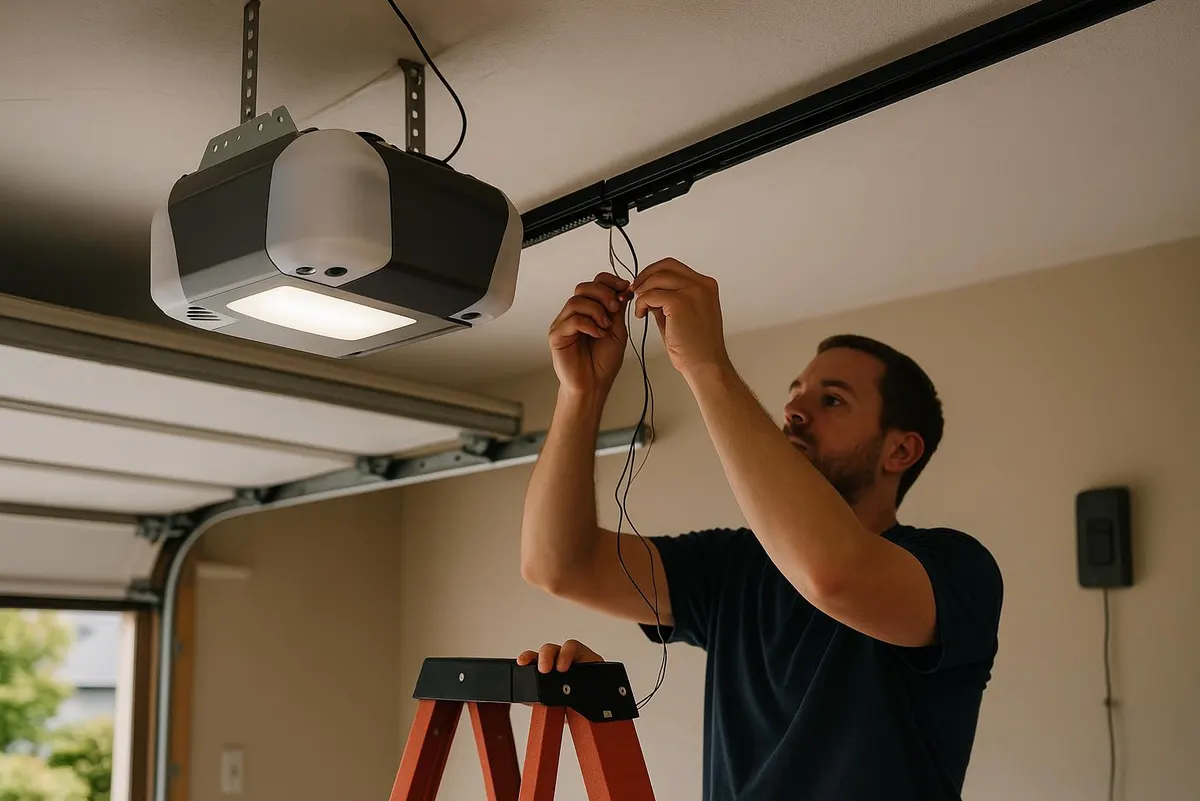
- Find the manual release cord. It's usually a red handle hanging from the trolley on the rail that runs from the opener to the top of the door.
- Brace the door before you disengage it. If the door is already up, have someone support it, or wedge it so it can't suddenly come down once it's disconnected from the opener.
- Pull the release cord straight down and toward the opener. This disconnects the trolley from the drive carriage, freeing the door from the motor.
- Lift with both hands, evenly, from the bottom. A properly balanced door should move smoothly and stay in place if you stop partway. If it feels heavy, drops on its own, or won't hold position, stop — that's a spring or cable problem, not something to force through.
- Prop it open if you need it open for a while. Clamp a pair of locking pliers onto the track just below a roller so the door can't roll back down while you're in and out.
Step-by-Step: Closing the Door Manually
- Remove any clamps or props holding the door open.
- Guide the door down slowly with both hands, keeping your fingers clear of the panel seams.
- Make sure it seats fully against the floor. A door that stops short or leans to one side when closing by hand usually means a track is slightly out of alignment — common after wind or hail has rattled the hardware — and worth having checked even if it still functions.
Step-by-Step: Re-Engaging the Opener Once Power Returns
- With the door fully closed, pull the release cord toward the door itself (the opposite direction from how you disengaged it). On most openers this reconnects the trolley to the carriage.
- If it doesn't click back into place right away, manually slide the trolley along the rail until it meets the carriage — you'll hear or feel it lock in.
- Test with the remote or wall button. The door should move through a full open-and-close cycle smoothly, without grinding, chain slap, or hesitation.
- Check the safety reversal. Wave a broom handle or similar object in the door's path while it's closing — it should stop and reverse immediately. This matters more than people think; a reversal sensor that's slightly out of alignment from a knock during the outage won't always show symptoms until you test it.
What's Fine to Handle Yourself vs. What Needs a Technician
Operating the release cord, manually lifting and lowering the door, and reconnecting the trolley are all normal homeowner tasks — every opener is built for this. Where it crosses into technician territory:
- The door won't hold its position when lifted partway (spring tension issue)
- Cables look frayed, loose, or off their pulley
- The opener grinds, hesitates, or the chain slaps the rail after reconnecting
- The safety reversal doesn't trigger during your test
- The travel limits need adjusting because the door no longer closes fully or stops too early — on many openers this is an electronic setting, and getting it wrong can mean a door that comes down with too much force
Why This Matters More Here Than in Milder Climates
Outages around Coppell tend to come with the kind of weather that also stresses garage door hardware directly — high winds, sudden hail, and in the colder months, ice that can stiffen lubricant on rollers and hinges and make a door feel heavier than it actually is. A door that was already slightly out of balance before the storm is far more likely to show it the moment you're operating it by hand in the dark.
When to Call Coppell Garage Door
If your door won't hold its position when lifted, if a spring looks damaged, or if the opener isn't reconnecting cleanly after an outage, that's where we come in. Our technicians handle spring repair and replacement and garage door opener repair and installation for homes throughout Coppell, Lewisville, Flower Mound, Carrollton, Irving, Grapevine, Farmers Branch, and Valley Ranch — and we offer emergency garage door service for situations that can't wait until morning.
If the next storm or power blip leaves your garage door stuck, call Coppell Garage Door. We'll get it moving safely and make sure it's ready for the next one.